
Ulysses Venturin
Founder
You are responsible for an event that cost six figures to produce. Hundreds of stakeholders will be in the room. Your CEO will deliver the most important speech of the quarter. A global sponsor expects highlight content by the end of the day. And you have 72 hours to select the production company that will capture all of it.
This is not a purchasing decision. It is a risk management decision. The wrong production partner at a high-stakes corporate event does not just produce inferior footage — it creates irreversible gaps in your brand narrative, breaks promises to sponsors, and forces your internal team into damage control mode when they should be focused on the event itself.
This guide is written for corporate event directors, marketing leaders, and conference organisers who need to evaluate audiovisual production companies with precision — not hope.
Part 1: Understanding What You Are Actually Buying
Most event organisers think they are buying footage. They are not. They are buying the certainty that the right moments will be captured, in the right quality, at the right time — and that the resulting content will function as a strategic asset long after the event ends.
Research from Nielsen (2023) found that 65% of consumers are more likely to trust brands that produce high-quality, professional-looking video content. For B2B events, that trust dynamic applies directly to how attendees, sponsors, and media perceive your organisation based on the production quality they experience and consume after the event.
"Production quality directly impacts brand perception. Professional colour grading, clean audio, thoughtful lighting, and intentional composition communicate competence before a single word is spoken."
The footage from your annual conference, your product launch, or your industry summit is not a record — it is a brand asset. It will be embedded in pitch decks, shared on LinkedIn, screened at the next event, and used in campaigns for the next 18 months. Its quality is your quality, in perpetuity.
Part 2: The 10 Questions Every Buyer Must Ask
1. "Can I see your pre-production documentation for a past event?"
A world-class production company builds a detailed operational plan — sometimes called a Crew Plan — before a single piece of equipment is transported to a venue. This document maps crew positions, equipment redundancies, contingency protocols, and venue-specific logistics. If a company cannot produce this, they are improvising at your expense.
2. "Do you offer same-day content delivery?"
For global conferences and trade shows, same-day highlight reels and social media cuts have become a competitive expectation. Not all production companies have the workflow infrastructure — dedicated on-site editing, fast data transfer pipelines, and review loops — to deliver this reliably. Ask for specific examples.
3. "What is your redundancy protocol for critical equipment?"
Professional production does not operate with single points of failure. Every camera, audio feed, and recording system should have a redundant backup. If the answer is vague or relies on "we've never had a problem," that is a red flag. Experienced teams assume failure can happen and prepare accordingly.
4. "Have you worked at our venue — or comparable venues internationally?"
Venue intelligence is non-negotiable. Lighting conditions, acoustic signatures, power grid limitations, and rigging constraints vary dramatically between venues. A production team with prior knowledge of the ExCeL London, Venetian Las Vegas, or CTICC Cape Town operates with a significant advantage over one arriving blind.
5. "Who specifically will be on-site — and what is their experience level?"
Many production companies operate as brokers, assigning junior freelancers to the job after winning the contract with a senior portfolio. Insist on knowing the lead director, lead camera operator, and lead editor by name. Ask to see their individual work samples.
6. "How do you handle multi-camera coordination at large conferences?"
Single-camera coverage at a major conference is not coverage — it is documentation. Multi-camera coordination requires pre-assigned positions, a live director or showrunner, and a clear communication protocol between operators. Ask how they structure this for events of your scale.
7. "Can you handle global events — outside your home market?"
If your events span multiple continents, your production partner needs to demonstrate genuine international experience: local contractor networks, equipment customs expertise, and cultural fluency. A portfolio that only shows domestic work is a signal.
8. "What deliverables do you commit to, and on what timeline?"
Get specific: raw footage archiving, edited highlights, social media formats (vertical cuts, square cuts), transcript-ready speaker recordings, and photography. Every deliverable should have a committed timeline — not an estimate.
9. "What does your pricing include, and what triggers additional costs?"
Travel, overtime, additional shooting days, revisions beyond the first round, and hard drive delivery costs are frequent sources of budget surprise. A professional production company offers transparent pricing structures. Ask for a detailed cost breakdown, not just a headline figure.
10. "What makes you different from a crew-for-hire?"
This is the most important question. The difference between a production company and a crew-for-hire is strategic ownership. A true production partner thinks about your objectives, anticipates your needs, and brings creative and operational intelligence to the engagement. A crew-for-hire shows up, presses record, and hands you a hard drive.
Part 3: Red Flags to Identify Before You Sign
- No documented pre-production process — only "we'll handle it on the day."
- Portfolio with no named clients or verifiable references.
- No case for redundancy when asked about equipment failure.
- Inability to specify who will be on-site.
- Same-day delivery offered without demonstrable workflow infrastructure.
- No international experience for multi-market events.
- Reluctance to provide a detailed cost breakdown.
Part 4: What Excellence Actually Looks Like
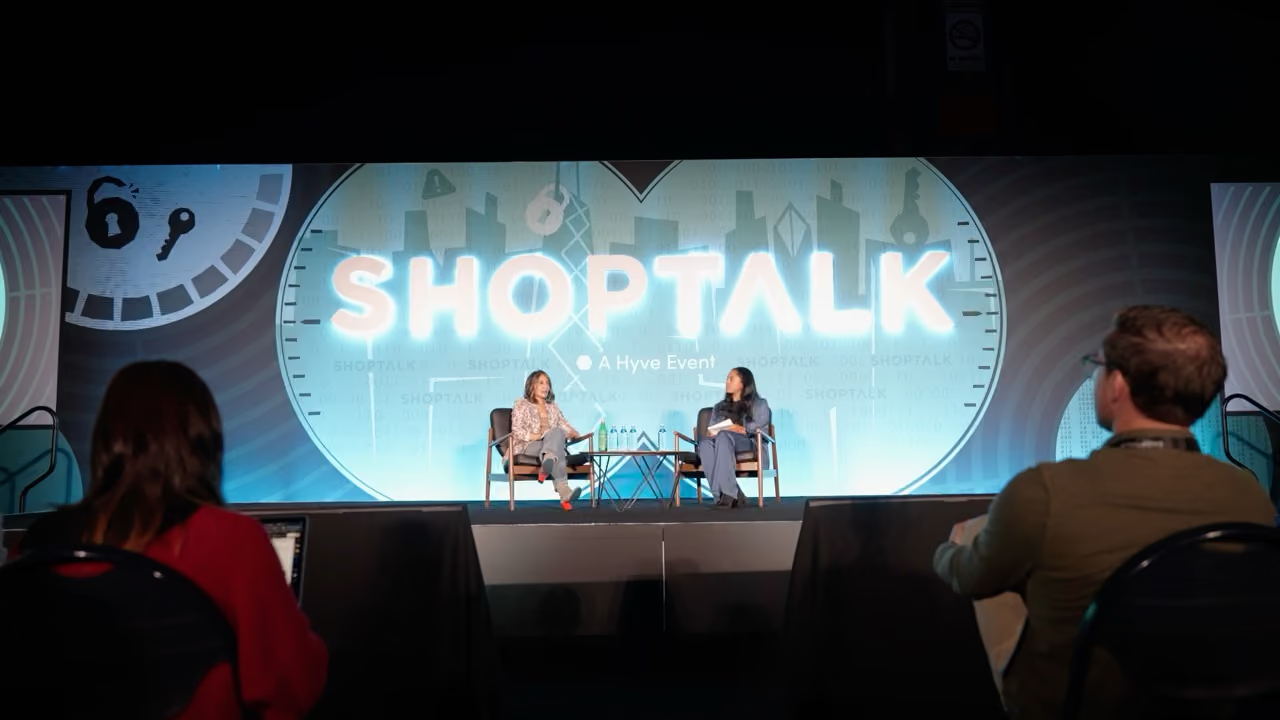
Shoptalk — one of the world's leading retail and technology conference series, operating across Las Vegas and Barcelona — describes their long-term production partner in these terms: "World class. We wouldn't want any other team as partners. You are truly a part of Team Shoptalk."
That level of partnership is the result of deep pre-production planning before every event, consistent crew quality across multiple markets and years, same-day delivery capability with professional editing infrastructure, proactive communication rather than reactive troubleshooting, and a production team that treats each event as a unique strategic project.
Part 5: The ROI Argument — Why Premium Production Pays
According to Wyzowl (2026), 82% of video marketers report good ROI from video — the highest figure ever recorded. HubSpot research shows that incorporating video in product pages increases purchases by 144%, and video-embedded emails generate 200 to 300% more click-throughs than text-only equivalents.
"55% of B2B buyers consider video the most helpful content type in their purchase decision process." — HubSpot / SageFrog Research
The content produced at your event is not a cost. It is a multiplier. A single day of premium production at your annual conference generates assets used across sales, marketing, internal communications, and brand campaigns for 12 to 18 months.
Frequently Asked Questions
How do I choose the right event video production company?
Evaluate pre-production capability (ask to see documentation), verify redundancy protocols, confirm who specifically will be on-site, and check for genuine international experience if your events are multi-market. A Crew Plan or equivalent pre-production document is one of the clearest indicators of professional-grade capability.
What should I ask an AV company before signing a contract?
Key questions include: What is your redundancy protocol? Who specifically will be on-site? Do you offer same-day delivery? Can you show pre-production documentation from a comparable event? What triggers additional costs beyond the quoted price?
What is same-day event video production?
Same-day production refers to the delivery of edited highlight content — including social media-ready cuts — within hours of an event concluding. This requires dedicated on-site editing infrastructure, fast data transfer, and an operational workflow built specifically for live event timelines.
How much does corporate event video production cost?
Costs vary by event scale, geography, crew size, deliverables, and post-production scope. Professional corporate event coverage in major markets typically ranges from four figures for single-day coverage to six figures for multi-day global productions with same-day delivery and full post-production.


